
Saturday, November 21 and Sunday, November 22
Amherst, MA
In Zhāng Zhongjing’s Píng Mài Fǎ, Balancing the Pulse Methods, he wrote:
上工望而知之,中工問而知之,下工脈而知之.
“The first work of the physician is to know through observation.
Next, there is knowing through asking.
Finally, there is knowing through touching the vessels.”
14 “Live” CEUs (NCCAOM & California)
Inner Circle Members
Full Price
Upgrade now to save, cancel at any time.
Daily Schedule
9am – 12pm: See patients, teaching abdominal, pulse diagnosis and inquiry diagnosis. Write herbal perscriptions. Q+A
12pm – 1pm: Lunch Break
1pm – 5pm: See patients, teaching abdominal, pulse diagnosis and inquiry diagnosis. Write herbal prescriptions. Q+A
14 “Live” CEUs (NCCAOM & California)
The Four Pillars of Diagnosis
Each patient encounter will draw upon the four classical approaches to diagnosis:
Looking diagnosis, in which we observe the patient’s demeanor, complexion, eyes, posture, responsiveness, movements, tongue, and the many other qualities revealed before and during the intake.
Asking diagnosis, in which we inquire carefully and purposefully, seeking the information needed to clarify the entire presentation without losing sight of the person before us.
Listening and smelling diagnosis, in which we listen not only to the patient’s words but also to the sound and quality of the voice, breathing, emotional tone, and other subtle resonances. At the same time, we attend to our own impressions and responses to the patient.
Touching diagnosis, in which students will palpate the pulses and abdomen. Through repeated hands-on practice with five patients each day, students will have an unusual opportunity to compare findings and calibrate their palpation skills with Sharon and with one another.
Seeing the Whole Presentation
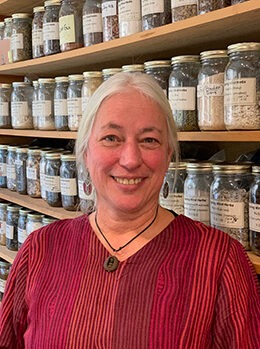
Once the information has been gathered, Sharon will demonstrate how she sorts what is significant from what is secondary or incidental. She will show how a complex collection of symptoms, signs, pulse qualities, and abdominal findings can be organized into a succinct and reliable diagnosis that encompasses the whole patient.
Her diagnostic process is grounded in the physiology expressed in the Huángdì Nèijīng and brought to clinical life by Zhāng Zhòngjǐng in the Shānghán Zábìng Lùn. This is a classically based jīngfāng clinic in which diagnosis is not merely matched to a disease name or list of symptoms. Instead, the patient’s presentation is understood through the movement and physiology of the body as a whole.
From Diagnosis to Method to Formula
A clear diagnosis reveals a treatment method. The treatment method, in turn, guides the construction of the formula.
For every patient, Sharon will discuss:
- How she organizes the information gathered during the intake
- Which findings carry the greatest diagnostic significance
- How the pulse and abdominal findings clarify or challenge the initial impression
- How she articulates the diagnosis and treatment method
- How the diagnosis leads to a classical formula pattern
- Why a particular formula is selected or modified
- How individual herbs and dosages are chosen
- How the final prescription is written
Students will be able to follow and question the entire process, including the clinical decisions that might otherwise remain hidden in the experienced practitioner’s mind. Sharon is particularly skilled at slowing down and deconstructing her clinical reasoning so that students can see not only what she decides, but how she arrives there.
Refund Policy: Students cancelling up to 2 weeks in advance will be provided a 50% refund. No refunds will be provided less than 2 weeks before the event.